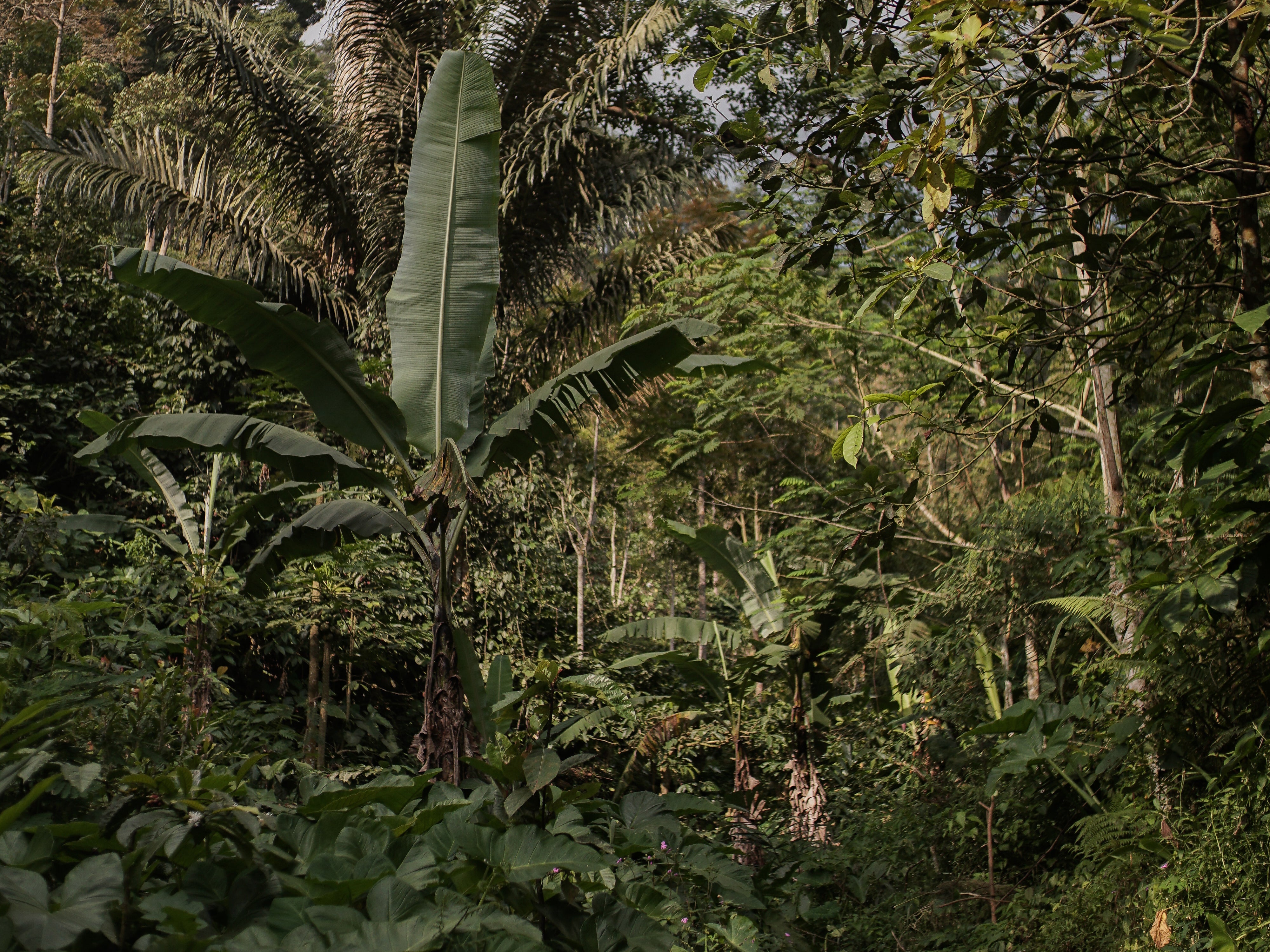
In the villages where we work, there is a way of farming called Tumpang Sari.
Instead of planting one crop alone in a bare field, you plant many together. Corn beside beans beside cassava. The tall ones give shade. The legumes feed nitrogen back into the soil. The deep roots and the shallow roots hold the earth in place so the rains cannot wash it away. And if one crop has a hard season, the others carry the harvest. Nothing stands alone. Everything is stronger because it grew up entangled with something else.
This is how we built Rumah SukkhaCitta, our new flagship in Ashta District 8.
Not one hand, but many. Different people, different crafts, different ways of knowing, all planted together until something rose that none of us could have grown by ourselves. Our flagship is, in the most literal sense, a Tumpang Sari. And I want to tell you how it grew.
Why we call it home
We named our flagship Rumah, Indonesian for ‘home’, and we meant it.
For ten years, SukkhaCitta has lived in homes. In the kitchens of Ibus who taught me how indigo sulks and blooms depending on the weather. On floors where the dye pot sits beside the morning rice. In fields where cotton is grown the slow way, the regenerative way, the way that gives back to the soil instead of bleeding it dry.
So when we finally built a place in the city, it could only be one thing. A home. A place where Jakarta can come and sit with the village awhile. Where you can stand beneath a wooden roof raised by hands in Central Java, wearing a kebaya dyed by hands in a village you may never visit, and feel — all at once, in your body — how close together all of it really is. The farm and the closet. The soil and the silk. The Ibu and you.
For the first time in ten years, you can stand inside the whole story. From farm to closet, under one roof. Our roof.

A decade of joy
People ask me what ten years feels like, and I never know what to say, because it does not feel like a number. It feels like faces.
It feels like Ibu Linna laughing so hard at how badly I tied my first bandana that she had to sit down. It feels like being told, almost in passing, that the difficult seasons make the strongest thread. Not as wisdom, just as a fact of a life lived close to the land. It feels like the morning our very first piece sold, and what that single sale meant for a family hundreds of kilometers from any boutique.
Ten years is a thousand mornings like that.
Not a tidy line going up and to the right, but a long, dizzying, wholehearted apprenticeship. Me, learning from the women of Indonesia's villages what regeneration actually means when it is not a word on a hangtag but the difference between a living soil and a dead one.
I came believing I had something to give them, and I left understanding it was the other way around: They were holding wisdom the rest of the world had forgotten how to hear.
And it has added up to something I can hold in my hands. Through our foundation, our craft schools now reach women across Java, Bali, and Flores. Women who today earn fair living wages, who are restoring their own soil, who no longer have to choose between feeding their families and keeping their heritage alive.
That is what ten years built. Not a brand. A different life, for real people, in real villages.
The Ibus shook my soul awake. They took the story I thought my life was going to be and rewrote it, page by page. I came believing I had something to give them, and I left understanding it was the other way around. They were holding wisdom the rest of the world had forgotten how to hear. Every thread we make, every story we tell, every reason SukkhaCitta exists at all: it begins with them.
Rumah SukkhaCitta is a love letter to those ten years. To those women. This is not a business milestone. It is a sacred labor of love, and I would build it a hundred times over.

The hands that grew it with us
Here is the part that makes my heart full.
We did not hand this dream to a single firm and wait for the keys. We gathered a circle. Collaborators who each carried something we could not, who were willing to grow something slower and stranger and more alive than any ordinary shop. This is our Tumpang Sari. Every one of them rooted beside the next, making the whole far stronger than the sum.
AGo Architects held the vision. They understood, almost before we said it, that we did not want a concept store, we wanted a home. So they drew us one: a tiered wooden roof rising at the very heart of the space, like all traditional Indonesian homes (such as the rumah panggung and joglo), with every material and design element feeling warm and familiar. Materials that are honest and rooted in Indonesia, but still with a touch of modernity: From traceable laminated timber, furniture made from solid wood and bamboo, natural local stones, and local handmade tiles. Their design does the hardest thing design can do: it gets quiet, so the craft can sing.
Intereka, our contractor collaborator for years, took those drawings and made them something you can walk through and touch. Anyone who has built anything knows this is where dreams usually go to die, in the gap between the beautiful rendering and the stubborn real. They held that line for us, carrying intention into structure, one patient detail at a time.
Santai gave us the furniture, pieces that quietly ask you to slow down, to sit, to stay a breath longer than a transaction ever would. Exactly what a home is for.
And then there is the wood. Because if this is a home made of timber, then the timber is everything.
Timberlab, from Demak in Central Java, believe what we believe: that wood is never just a material. They are the ones who showed us what timber could become. How to design with it. How to engineer it into a home that stands on its own, light and strong, for decades. A tree spends its life drinking carbon from the sky, and when you build with it, that carbon stays in the beams. And none of it is permanent. If this home ever needs to grow or move, it can come apart and be built again, somewhere new.
Buana Triarta gave us the wood, with a lineage we could trust. For thirty years they have worked tropical hardwood, sourcing only from certified forests, tracing a single plank back to the ground it grew from. Because of the way this wood is sourced and built, it does not have to end with one home. If one day we need more room, or a different use, or a new place altogether, the beams come apart and are built again. To respect a material is to give it life again, and again.
And here is the detail I keep turning over like a stone in my pocket: the wood for our Jakarta flagship traveled here from Kalimantan, traceable from forest to column. The same farm-to-closet thread we have followed all along, only now it is farm-to-home. The whole philosophy of SukkhaCitta, standing up in beams over your head.

Every choice, a promise to the future
Nothing in this home was chosen only because it was lovely.
We chose timber that stores carbon and remembers the forest it came from. We chose to leave materials honest and bare, because that is how the Ibus taught us to treat what the earth gives. With reverence, as though the future were already in the room. Because it is.
Every single choice in this house is a choice about the world we are weaving together, and I wanted that future built right into the walls where you could lean against it.
This is what I mean when I say our work is to unearth the regenerative wisdom that was always here. In our villages, our craft schools, the women who never once stopped practicing it, and lift it into the light where it belongs.
We did not invent any of this. We were simply given the great privilege of carrying it and sharing it with you. Together, reconnecting with what matters.
Why now, of all moments
Let me be honest with you, the way I always am.
It took everything to make this happen. Everything. And there were a hundred reasons, especially right now, to make ourselves smaller instead. To wait for a better economy, an easier season, to hold back, to quietly stop building.
We chose to build anyway. To keep showing up. To choose trust over fear, again and again, on the days it made no sense. To hold on to hope precisely because hope is in such short supply.
Because if a decade working in the villages taught me one thing, it is that the difficult seasons really do make the strongest thread.
You do not get to skip them. You grow through them. Entangled, leaning, held up by the others rooted beside you, or you do not grow at all.
Rumah SukkhaCitta is what hope looks like when it refuses to sit down.
Come home
So here is my invitation, and I mean it with my whole heart.
Come stand beneath our wooden roof. Lay your hand on a column that began as a forest in Kalimantan. Wear a piece dyed by an Ibu who, over ten years, has become something like family to me.
Feel the entire journey gathered into a single room. The farm, the field, the dye pot, the loom, the fabrics, and know that when you choose one of our pieces, you step straight into a story that is rewriting real lives.
Because you are the one who completes the loop. The story begins in the soil and travels through the hands of the Ibus, but it is not finished until it reaches you. Until you carry it out into the world. When you choose one of our pieces, the circle closes, and you become part of it.
This was never only about fashion. It is a home we grew together. Many hands, many crafts, all planted side by side, rising toward something none of us could ever reach alone.
Ten years ago, I asked whether what we wear could change lives. Come stand in this home, and I think you will feel the answer.
Welcome to Rumah SukkhaCitta. We have been growing it, all this time, for you.
Your nerd,
D