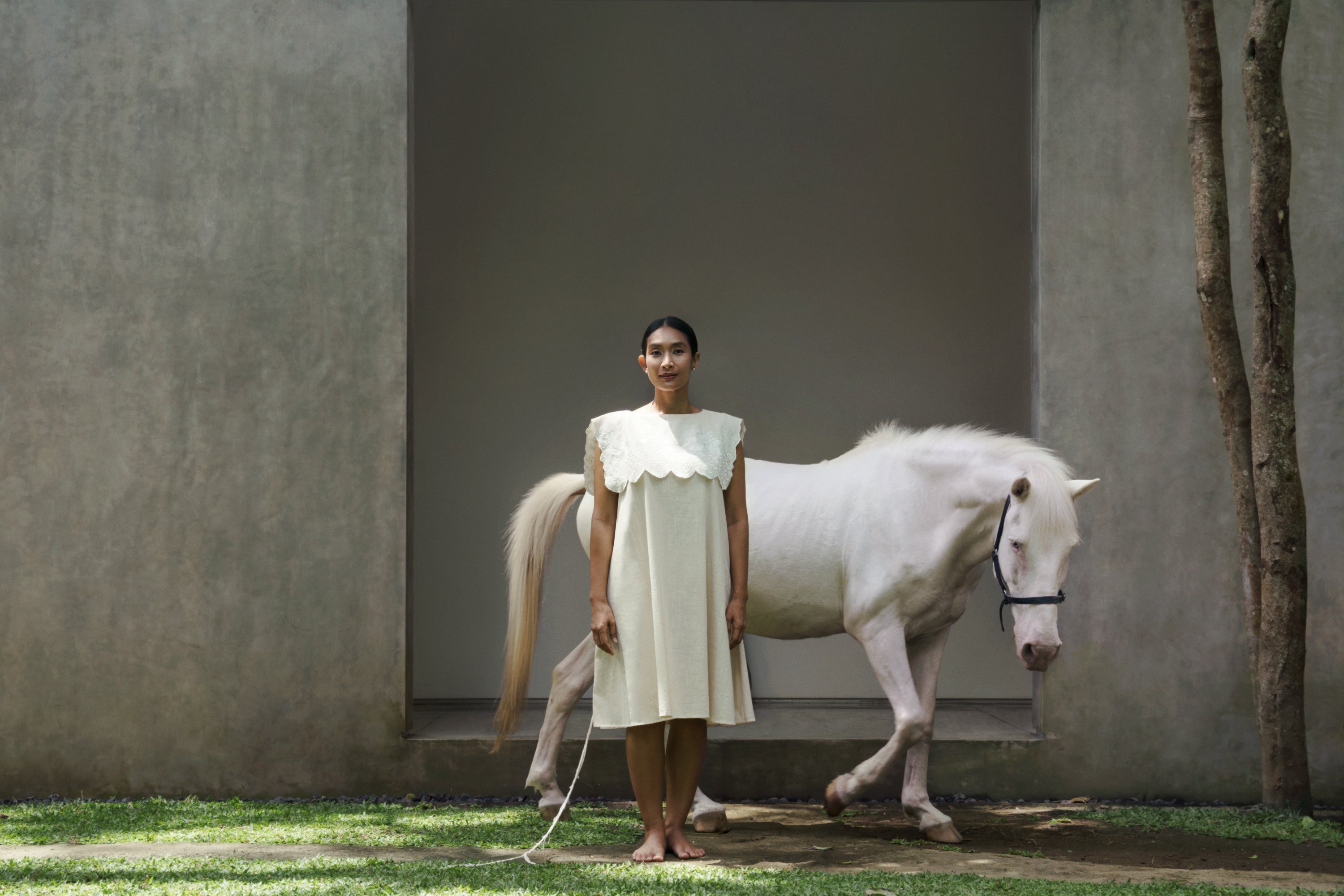
Retno Marsudi, United Nations Special Envoy on Water, in the SukkhaCitta Beskap in Angkasa Jacquard Light Indigo for Herworld Indonesia.
_
Most Beskap live in a garment bag. Worn once, to your own wedding. Perhaps twice, to yours and someone else's. Which is truly a shame for one of the most meaningful jackets in history.
Because a Beskap is more than formalwear. It is a statement. It is your armour as you face the world and do work that matters to you.
An Armor for Meaningful Work
There is a room you have to walk into. A table with people around it who have not decided about you yet. A pitch. A first day. A conversation you have rehearsed all week and still cannot predict.
You dress carefully that morning, because it is the one part of the day still within your control.
Then you put on the Beskap.
The collar stands high and firm against the back of your neck, and you find you cannot drop your chin. The shoulders are cut with structure through them, so they hold at their full width instead of rolling forward. You look up and you are standing the way you stand on your best days, without having done anything to arrive there.
Nothing about the room has changed. What has changed is that you will not spend the next hour making yourself smaller inside it.

Our Ibus in the SukkhaCitta Light Beskap in Kapas. The women who grew our regenerative cotton, in their own creations.
Where The Beskap Came From
Sometime in the nineteenth century, Mangkunegara IV was going to meet the king, but not at the kraton (the royal court). The meeting was at Langenharjo, a royal guest house located south of Solo in Central Java, and the full formality the court would have demanded was not really required out there.
In other words, he had nothing to wear.
Fortunately, this prince was quite creative. And so he took a Western coat and reworked it into Javanese form. The style kept the name of the place. Beskap Langenharjan. He was making no point about anything. He had a protocol problem and a coat.
Which means the Beskap originally began as a jacket a Javanese prince improvised, because the setting had changed and the old rule no longer fit it. A reinterpretation from the very first day it existed.
Which is precisely why the Beskap has become one of SukkhaCitta’s favorite canvases. Since it's launch in 2021, it has truly become a universal armor for men and women doing meaningful work around the world. Below, Chris Martin from Coldplay in his SukkhaCitta Beskap in Angkasa Batik.


Philosophy, sewn into the construction
Look at a traditional Beskap and something is deliberately off. The two halves do not meet in the middle. The front folds to the left and slants downward. The hem finishes at different heights. Every part of that is doing something.
The back sits higher than the front because the beskap was made to be worn with a keris, a dagger, which at court was carried tucked at the small of the back. Safely stowed, and still visible. The jacket had to make room without hiding it.
The buttons are stranger still. On the left, below the chest, three of them fasten the overlap. On the right, two more sit exactly opposite, and they fasten nothing at all. The Javanese call this pasren. They are there so the asymmetry reads as chosen rather than accidental.
Which tells you what kind of garment this is. Half the buttons on a Beskap have never held anything closed. They hold the composition together.
 Mikael Jasin, 2024 World Barista Champion, in his SukkhaCitta Anyam Beskap.
And the fastening itself carries a teaching. The Javanese word for a button is benik, and the lesson plays on the sound: that a person should have every action di-niknik, calculated and thought through before it is taken, in a way that costs nobody else anything. The lesson lives in the pun rather than in the object.
The slant does that work physically. A straight row is the quick way to close a jacket. A slanted overlap asks for your attention, and by the time you are dressed a little time has passed that otherwise would not have. Eling lan waspada. Mindful, watchful, unhurried.
On the mornings that matter, fastening a beskap takes a few seconds longer than a shirt. A prince built that delay in on purpose, and it is the one part of the design nobody has since found a reason to remove.
We no longer leave space for a dagger at the back of ours. We kept the fold, the slant, and the buttons that fasten nothing, because that is where the thinking lives.
Soft, strong, and deeply rooted. Yours to wear for years, not wears.

World renowned oceanographer Dr. Sylvia Earle and Franki Gozali receiving his lifetime achievement award in the SukkhaCitta Beskap in Angkasa Jacquard ThreeBark Red.
180 days to craft, from farm to closet
That is how long it takes to make one of our regenerative cotton Beskap, from farm to closet. Most of it is waiting. That element of patience and restraint again, this time in the making rather than the wearing.
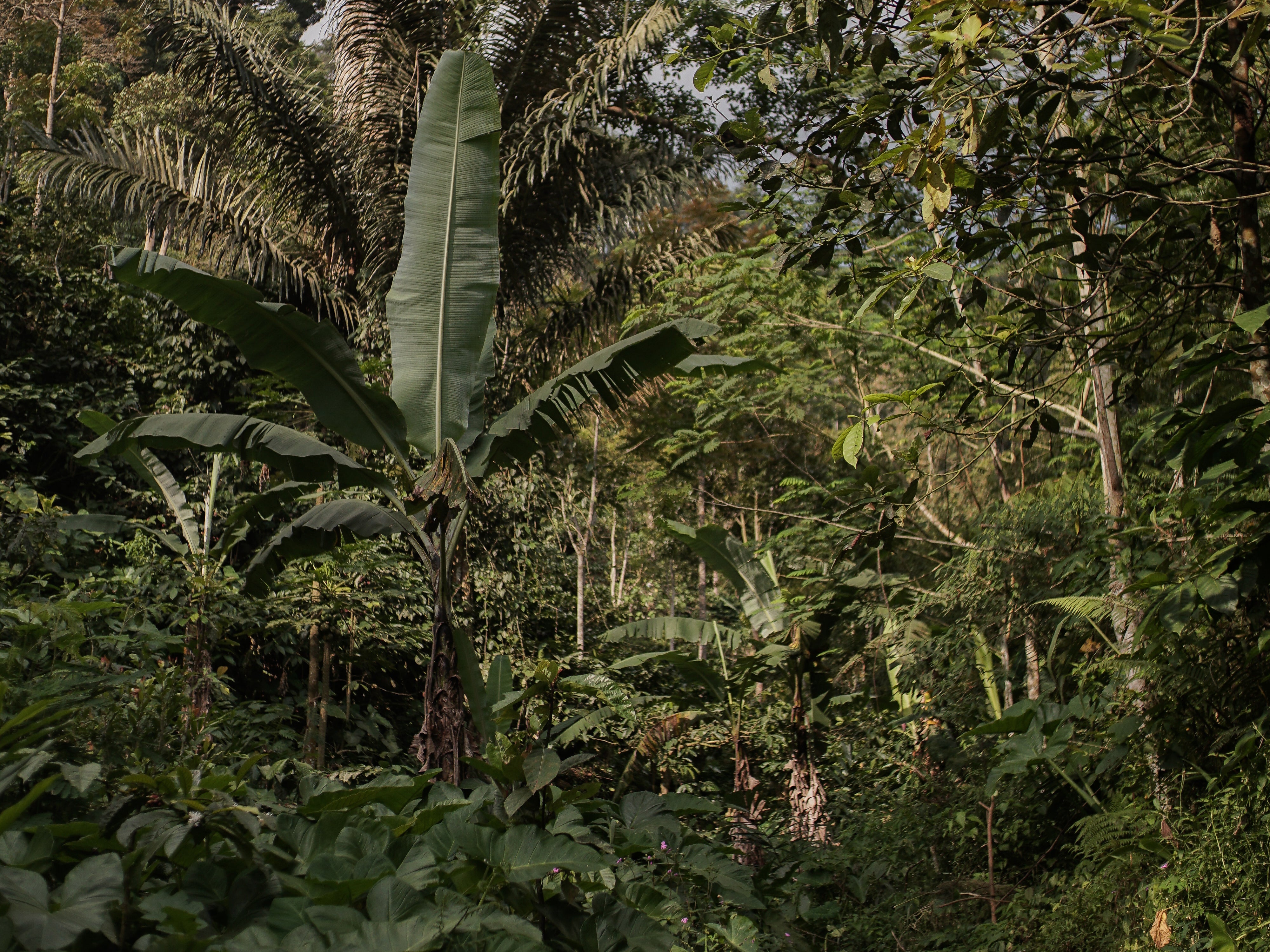
Cotton grown in soil we are working to repair, using Tumpang Sari, the intercropping our Ibus' grandmothers used. Handspun. Woven on looms that run on no electricity at all. Dyed with plants that were medicine long before they were pigment, over weeks rather than hours.
 From farm to closet, each SukkhaCitta Beskap takes 180 days to craft.
Half a year. Which means the SukkhaCitta Beskap that eventually becomes yours was already underway months before you went looking for one. Someone was spinning the thread for it while you were still living the year that led you here.
For me this is the most meaningful part of all of it. It gives back to the soil it came from. And it carries the work of the women who made it, across half a year of their attention, as the mastery it is.
A prince changed this jacket once. The courts changed it after him. It has been remade and handed on and carried into rooms nobody in Solo could have imagined, and every person who wore one left something in it.
It is never finished. And what it becomes next is yours to write.
 As for me, this SukkhaCitta Beskap in Angkasa Jacquard Light Indigo has become my daily uniform. I wear it buttoned for formal events, and opened as a jacket for a more casual everyday look. They're really perfect for travel, providing effortless sophistication and warmth through Autumn weather.
_